




Marine Battery Guide: Lithium vs AGM vs Lead-Acid (How to Choose)

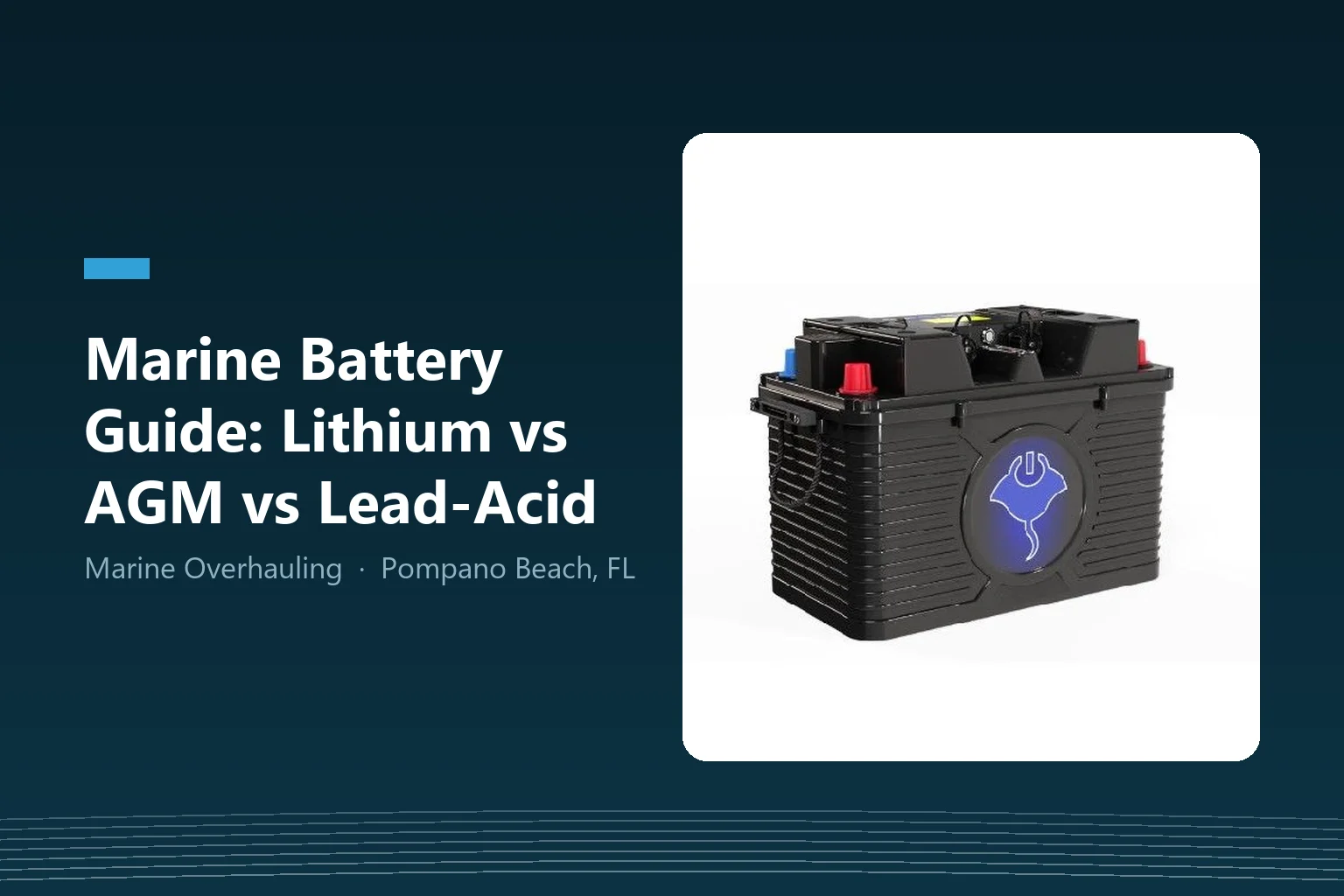
The right marine battery depends on the job. A battery that’s great for cranking your engine is the wrong choice for running electronics all weekend. This guide breaks down battery types, chemistries, and how to choose and size the right one for your boat.
Marine electrical service and installation in South Florida
Marine Overhauling handles marine electrical work, from batteries and chargers to complete systems, with free quotes and a 5.0 rating on Google. Boat pickup and transport available for qualifying boats and projects.
Starting vs deep-cycle vs dual-purpose
- Starting (cranking) batteries deliver a big burst of current for a few seconds to start the engine. They don’t like being deeply discharged.
- Deep-cycle batteries deliver steady current over hours to run trolling motors, fridges, lights and electronics — and tolerate being run down and recharged repeatedly.
- Dual-purpose batteries compromise between the two — a good fit for smaller boats with a single battery.
Chemistry: lead-acid vs AGM vs lithium
| Flooded lead-acid | AGM | Lithium (LiFePO4) | |
|---|---|---|---|
| Upfront cost | Lowest | Medium | Highest |
| Lifespan (cycles) | 300–500 | 500–900 | 3,000–5,000+ |
| Usable capacity | ~50% | ~50% | ~90–100% |
| Weight | Heavy | Heavy | ~⅓ lighter |
| Maintenance | Top up water | None (sealed) | None |
Lithium (LiFePO4) costs more upfront but delivers far more usable capacity, much longer life and half the weight — so on a cost-per-cycle basis it’s often the cheapest option over the life of the boat, especially for house and trolling banks.
How to choose
- Engine starting only? A quality starting or dual-purpose battery is plenty.
- Running a house bank, electronics or a trolling motor? Go deep-cycle — and seriously consider lithium boat batteries if you’re off the dock for long stretches.
- Tight on space or weight? Lithium wins on both.
Sizing your bank (amp-hours)
Add up the current draw (amps) of everything you run, multiply by the hours you’ll run it, and that’s your amp-hour (Ah) demand. With lead-acid/AGM, double it (you only use ~50%); with lithium you can use nearly the full rating. Always leave headroom for a bad-weather day.
Which lithium battery for which job
These are in-stock examples from the three lithium brands we carry, matched to the most common upgrades:
- 24V trolling motor bank: the Abyss 24V 60Ah trolling motor kit, or the Lithium Pros 24V/75Ah in Bluetooth and NMEA 2000 versions. One 24V battery replaces two 12V batteries in series.
- 12V house bank: the Abyss 12V 220Ah with NMEA 2000, the Lithium Pros 12.8V/150Ah, or the Precision Sonar Smart Battery in 100Ah and 150Ah.
- Starting and house in one battery: the Lithium Pros 12.8V/110Ah starting/deep cycle or the Abyss 24V 110Ah dual purpose.
- 36V and 48V systems: the Precision Sonar 36V 65Ah for 36V trolling motors, or the Abyss 48V 125Ah house battery.
Browse everything by brand: Abyss Battery, Lithium Pros and Precision Sonar, or see all lithium boat batteries in stock.
Shop batteries
Explore our lithium boat batteries and marine batteries, plus onboard battery chargers to keep them topped up. Questions about switching to lithium or sizing a house bank? Our marine electrical installation team can spec and fit it — talk to our team — we’ll help you get it right.
Lithium boat battery FAQ
Can I swap my AGM batteries for lithium without changing anything else?
Usually the battery itself drops into the same tray, but the charging side needs a check: the charger, and sometimes the alternator regulator, must have a lithium (LiFePO4) charge profile. Many modern marine chargers do; older chargers can float at the wrong voltage. We verify this as part of every lithium installation.
Will a lithium battery work with my trolling motor?
Yes. For 24V and 36V motors, a single 24V or 36V lithium battery replaces two or three 12V batteries, which saves weight and wiring. Check the motor manufacturer’s voltage limits and pick a battery rated for trolling duty.
How long do lithium marine batteries last?
LiFePO4 marine batteries are rated for 3,000 to 5,000 or more charge cycles, against roughly 300 to 500 for flooded lead acid and 500 to 900 for AGM. Used every weekend, that is the difference between replacing batteries every few seasons and keeping the same bank for many years.
Are lithium boat batteries safe?
Marine lithium batteries use LiFePO4 chemistry, the most thermally stable of the common lithium chemistries, and quality marine batteries include an internal battery management system (BMS) that protects against over-charge, over-discharge and short circuit. Correct charger settings and properly sized wiring complete the safety picture, which is why we recommend a professional check on any conversion.