




Marine Air Conditioner Pump: How to Size, Choose and Replace It

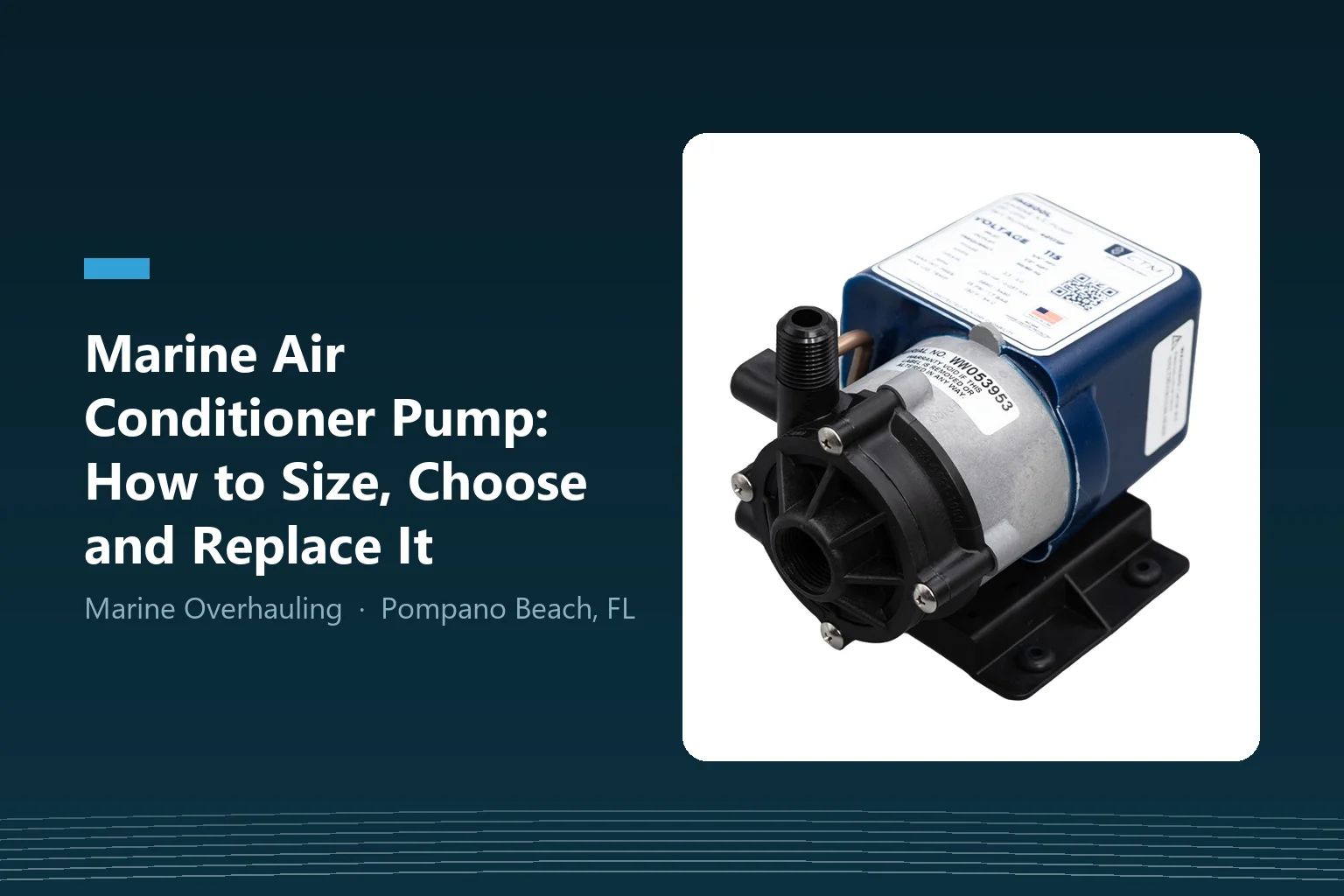
A self-contained marine air conditioner does not cool with air like the unit in your house. It dumps its heat into seawater, and the seawater pump is the part that keeps that water moving through the condenser. When the pump is undersized, air bound or worn out, the air conditioner blows warm air or shuts itself down on a high pressure fault. This guide explains how to size the pump from your unit’s own spec sheet, which type fits your boat, and the installation rules that decide whether it will last.
What the seawater pump does
Seawater enters through a thru-hull and seacock, passes a strainer, goes through the pump, flows through the condenser coil inside the air conditioner and leaves through an overboard discharge. If the flow drops, the refrigerant cannot shed its heat, pressure climbs and the unit protects itself by stopping. That is why a weak or intermittent stream from the overboard discharge is one of the first things to check when a marine air conditioner stops cooling. Our CTM A/C troubleshooting guide walks through the other symptoms part by part.
Step 1: find the seawater flow your unit needs
Every self-contained unit lists a seawater or condenser water flow on its spec sheet. Pump ratings are usually given in gallons per hour, so multiply GPM by 60 to compare them. These are the figures published for units we carry:
| Air conditioner | Capacity | Seawater flow | In GPH |
|---|---|---|---|
| CTM CT-6 | 6,000 BTU | 2.5 GPM | 150 GPH |
| CTM CT-10 | 10,000 BTU | 5 GPM | 300 GPH |
| CTM CT-12 | 12,000 BTU | 5 GPM | 300 GPH |
| CTM CT-16 | 16,000 BTU | 8.3 GPM | 500 GPH |
| Velair i10VSD 115V | 10,000 BTU | 3.2 GPM | 192 GPH |
| Velair i16VSD 115V | 16,000 BTU | 4.5 GPM | 270 GPH |
| Velair i21VSD 230V | 21,000 BTU | 5.3 GPM | 318 GPH |
Two things stand out. Brands publish different flows for the same capacity, so always read the number for your exact model instead of a generic chart. And the figure is a minimum for the condenser, not the pump rating you should buy.
Step 2: leave headroom above that number
A pump’s rated GPH is measured with almost no lift. Once it has to push water up to the air conditioner, through the hose, the strainer, the elbows and the condenser coil, the real flow is lower. The CTM PM500L, for example, is rated at 500 GPH but lists a maximum head of 19 feet, and flow falls as you approach that height. Choose a pump rated comfortably above the flow your unit needs, and more so on long hose runs or when the pump sits far below the air conditioner.
If one pump feeds more than one air conditioner, add the flows of every unit on the loop and size the pump above the total.
Step 3: pick the pump type
| Pump | Rated flow | Voltage | Typical use |
|---|---|---|---|
| Seawater Circulation Pump 250 GPH | 250 GPH | 115V | Listed for systems up to 10,000 BTU |
| CTM PM250L / PM250LH | 300 GPH | 115V / 230V | Small single units |
| Seawater Circulation Pump 500 GPH | 500 GPH | 115V | Listed for systems up to 16,000 BTU |
| CTM PM500L / PM500LH | 500 GPH | 115V / 230V | Single units up to the mid-size range |
| CTM PM1000L / PM1000LH, PM1000A / PM1000AH | 1,000 GPH | 115V / 230V | Large units or two units on one loop |
| CTM bronze PCX1500, PCX2100, PCX3000, PCX3600 | 1,500 to 3,600 GPH | 115 / 230V | Multi-unit systems and chillers |
Magnetic drive submersible pumps (the CTM PM series) have no shaft seal: the motor turns the impeller through a magnet, so there is no seal to weep seawater. The PM250 and PM500 are epoxy encapsulated and can run submerged or in open air, and the PM500 is ISO 8846 ignition protected. They are the usual choice for one or two air conditioners.
Bronze centrifugal pumps (the CTM PCX series) use a marine bronze case and impeller and move far more water. They are built for larger systems where one pump serves several air conditioners or a chilled water plant.
Voltage has to match. Every pump in the list comes in, or is wired for, a specific voltage. Buy the 115V model for a 115V system and the 230V model, usually marked with an H, for a 230V system.
Installation rules that decide how long it lasts
- Mount it below the waterline. These pumps are not self-priming. They need a flooded suction, which means seawater must reach the pump by gravity before it starts.
- Never let it run dry. On the PM250 and PM1000 the impeller is lubricated by the water it pumps, so running dry damages it. The PM500 adds run dry protection that shuts it down on overheating and lets it resume once cool, but it still needs water to work.
- Keep the strainer before the pump. Sea grass and shell growth in the strainer or thru-hull starve the pump just as much as a failing motor. Clean it first when flow drops.
- Route the hose without high loops. Air trapped in a high point can air lock the pump and stop the flow even with the seacock open.
- Use the right location. For engine room installations, pick a pump listed as ignition protected, such as the PM500 series or the seawater circulation pumps.
Replacing a Dometic or older pump
When a pump fails, the easiest swap is a model with the same flow, the same voltage and similar connections. Two CTM pumps list Dometic equivalents on their product pages: the CTM PM1000LH is a direct replacement for the Dometic PML1000 230V (part number 225500276), and the CTM PM1000AH lists the Dometic PMA1000C (225500069) as its equivalent. The bronze PCX pumps show their cross-reference numbers on each product page. Check the inlet and outlet thread sizes against your existing plumbing before you order.
What size pump do I need for my marine air conditioner?
Start from the seawater flow printed on your air conditioner spec sheet and convert it to gallons per hour by multiplying GPM by 60. A 12,000 BTU CTM CT-12 calls for 5 GPM, or 300 GPH. Then choose a pump rated comfortably above that number, because a pump only reaches its rated flow with almost no lift, and every foot of height, hose run and fitting reduces it.
Can one pump run two marine air conditioners?
Yes, a single seawater pump can feed several units when its flow covers the sum of all of them. Add the seawater flow of every unit on the loop and size the pump above that total. On larger systems this is where the 1,000 GPH submersible pumps and the bronze centrifugal pumps come in.
Are marine air conditioner pumps self-priming?
No. The CTM magnetic drive and bronze centrifugal pumps are not self-priming, so they must be mounted below the waterline with a flooded suction, meaning seawater reaches the pump by gravity. A pump mounted above the waterline will lose prime and stop moving water.
Is there a CTM replacement for a Dometic air conditioner pump?
Yes. The CTM PM1000LH is listed as a direct replacement for the Dometic PML1000 230V, part number 225500276, and the CTM PM1000AH lists the Dometic PMA1000C, part number 225500069, as its equivalent. The CTM bronze PCX pumps show their cross-reference numbers on each product page.
Shop pumps or get it installed
Every pump above is in our Marine A/C Pumps category, and strainers, capacitors, switches and control boards are in Marine Air Conditioning Parts. Replacing the whole unit? Size it with our marine air conditioner BTU sizing guide and compare brands in CTM vs Dometic vs Velair. In Pompano Beach and across South Florida we also install and service marine air conditioning: call (786) 277-2596 for a quote.