




12 Volt Marine Air Conditioner: DC Units vs Inverter Kits

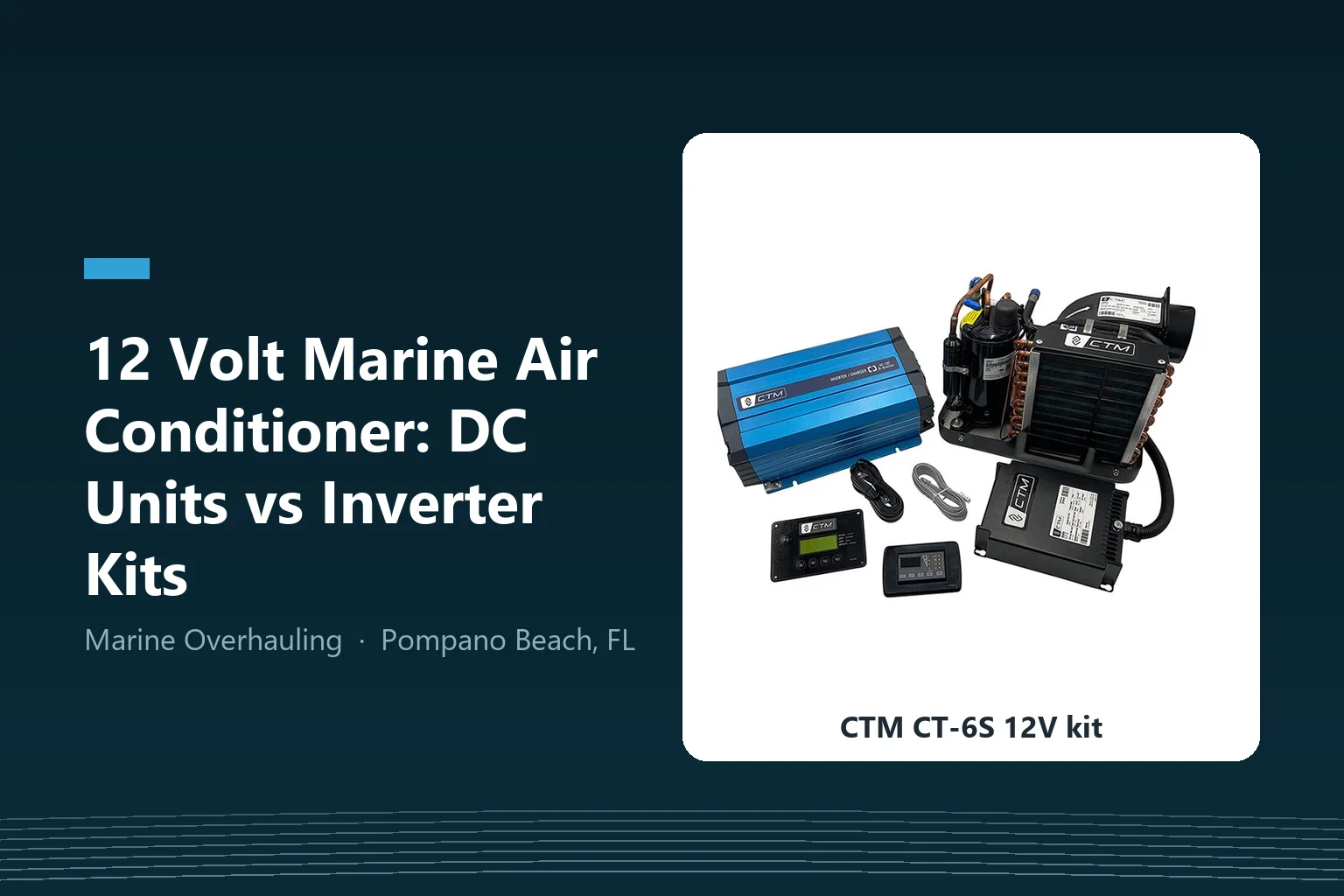
Running air conditioning at anchor without a generator is one of the most asked questions in boating. Search for a 12 volt marine air conditioner and you will find two very different things sold under the same name: units built around a DC compressor that runs straight from the battery, and kits that pair a standard 115 V marine air conditioner with an inverter. This guide explains how each one works, how much power they really pull from your batteries, and where the CTM 12 V kits we sell fit in.
The short answer
- A true DC unit uses a compressor designed to run on 12 V (or 24 V and 48 V) power. There is no inverter between the battery and the air conditioner.
- An inverter kit uses a regular 115 V self-contained unit plus an inverter that turns 12 V battery power into 115 V AC. The CTM CT-6S 12V kit and the CTM CT-10DCN both work this way: CTM lists the air conditioner at 100 to 120 V, and the kit includes a 1200 W inverter.
- Either way, the battery bank decides how long you get cool air. A 6,000 BTU unit pulls around 50 A from a 12 V bank while the compressor runs, so size the batteries before you choose the air conditioner.
How a 12V inverter kit works
The kit has three parts: a self-contained marine air conditioner, an inverter, and the wiring and control to connect them. The inverter takes 12 V DC from your house bank and produces 115 V AC for the air conditioner. In the CTM CT-6S kit, the inverter is rated at 1200 W with a pure sine wave output, accepts 10.5 to 16.5 V DC input and is listed at more than 88% efficiency. Because the air conditioner itself is a standard CTM unit, you get the same titanium condenser coil, turbo blower, reverse cycle heating and universal control board as the 115 V models, and the unit keeps the same footprint as the CTM self-contained units it is based on.
The price of that flexibility is conversion loss. Every watt the air conditioner uses passes through the inverter first, so the battery has to supply a little more than the air conditioner consumes. A true DC unit skips that step.
CTM CT-6S 12V kit and CT-10DCN side by side
| Feature | CTM CT-6S 12V kit | CTM CT-10DCN |
|---|---|---|
| Cooling capacity | 6,000 BTU | 10,000 BTU |
| Air conditioner voltage | 100 to 120 V | 100 to 120 V |
| Input current, cooling / heating (CTM spec) | 4.5 A / 5.6 A | 6.7 A / 8.8 A |
| Inverter included | 1200 W, pure sine wave | 1200 W, with inverter panel and cable |
| Control included | CTM Elite II digital control | CTM Easy Cool display (3.5 in, or 2.4 in Mini), NMEA 2000 starter kit and humidity and temperature sensor |
| NMEA 2000 kit for control from an MFD | Not included | Yes (Garmin EmpirBus and OneHelm, Raymarine YachtSense) |
| Start current reduction | Integrated EasyStart, 65 to 75% lower start current | Compatible with Micro-Air EasyStart soft starters |
| Reverse cycle heating | Yes | Yes |
| Refrigerant | R410A | R410A |
| Seawater connections | 5/8 in in and out | 5/8 in in and out |
Specifications from CTM’s published data for the CT-6 and CT-10DC units and from the kit contents listed by CTM’s US distributor.
How many amps it pulls from a 12V battery
You can estimate the battery draw from CTM’s own numbers. Multiply the input current by 115 V to get the power the air conditioner uses, divide by the inverter efficiency, then divide by 12 V. These are estimates for when the compressor is running; when the thermostat is satisfied the compressor stops and the draw drops.
| Mode | Air conditioner power | From the battery (88% inverter) | Approximate amps at 12 V |
|---|---|---|---|
| CT-6, cooling (4.5 A) | about 520 W | about 590 W | about 49 A |
| CT-6, heating (5.6 A) | about 640 W | about 730 W | about 61 A |
| CT-10, cooling (6.7 A) | about 770 W | about 880 W | about 73 A |
| CT-10, heating (8.8 A) | about 1,010 W | about 1,150 W | about 96 A |
To estimate run time, divide the usable amp hours of your bank by the amps above. For example, 100 Ah of usable capacity runs a CT-6 compressor for about 2 hours of continuous cooling, and 400 Ah of usable capacity runs a CT-10 for about 5.5 hours. Real run time is usually longer because the compressor cycles, and shorter if the cabin is hot, poorly insulated or in direct sun. If you are planning a new bank, our lithium vs AGM vs lead acid battery guide explains why usable capacity differs so much between battery types.
Which one fits your boat
- Small cabin, overnight at anchor: the CT-6S 12V kit keeps the battery draw lower and comes ready with inverter, control and integrated EasyStart.
- Larger cabin or boats with a digital switching system: the CT-10DCN gives 10,000 BTU and NMEA 2000 control, so you can run the air conditioner from a compatible Garmin or Raymarine display. Plan a bigger bank for it.
- Mostly at the dock or with a generator: you may not need a 12 V kit at all. A standard 115 V unit such as the CT-6S with soft start runs on shore power or a generator without an inverter.
Not sure about the size? Our marine air conditioner sizing guide walks through BTU per cabin, and CTM vs Dometic vs Velair compares the main self-contained brands.
Installation notes
A 12 V air conditioner moves a lot of current, so the DC side matters as much as the air conditioner. Cable size, fusing and the distance between the battery and the inverter all need to match the inverter’s draw, and the inverter has to be mounted in a dry, ventilated space. The air conditioner still needs a seawater pump, through hull and intake strainer like any self-contained unit. Every CTM unit carries a 3-year warranty when registered (first year parts and labor, second and third year parts only). Our technicians install marine air conditioning in South Florida; see our marine air conditioning service.
Can a marine air conditioner run on 12V batteries?
Yes, in two ways. A true DC unit runs its compressor directly from 12 V, while an inverter kit such as the CTM CT-6S 12V kit or CT-10DCN uses a 1200 W inverter to power a standard 115 V air conditioner from the battery bank. In both cases the size of the battery bank decides how long it can run.
How many amps does a 12V marine air conditioner draw?
Using CTM’s published input current and an inverter efficiency of 88%, a 6,000 BTU CT-6 draws about 49 A from a 12 V bank while cooling and a 10,000 BTU CT-10 about 73 A. Heating draws more, about 61 A and 96 A. The draw drops when the thermostat stops the compressor.
How long will my batteries run a marine air conditioner?
Divide the usable amp hours of the bank by the amp draw. As an example, 100 Ah of usable capacity runs a CT-6 for about 2 hours of continuous cooling and 400 Ah runs a CT-10 for about 5.5 hours. Compressor cycling, cabin size, insulation and sun exposure change the real number.
Why does soft start matter with an inverter?
A compressor pulls much more current for a moment when it starts than while it runs, and an inverter can only deliver a limited surge. Soft start reduces that start current: CTM states 65 to 75% lower start current for the EasyStart in the CT-6S kit, and the CT-10DC is compatible with Micro-Air EasyStart soft starters.
Shop CTM 12V marine air conditioners
The CTM CT-6S 12V kit and the CTM CT-10DCN ship from Pompano Beach, FL, with free US shipping on orders over $199. See all CTM marine air conditioners, or call (786) 277-2596 to plan the battery bank and installation with us.