




CTM Marine A/C Troubleshooting: Which Part Do You Need?

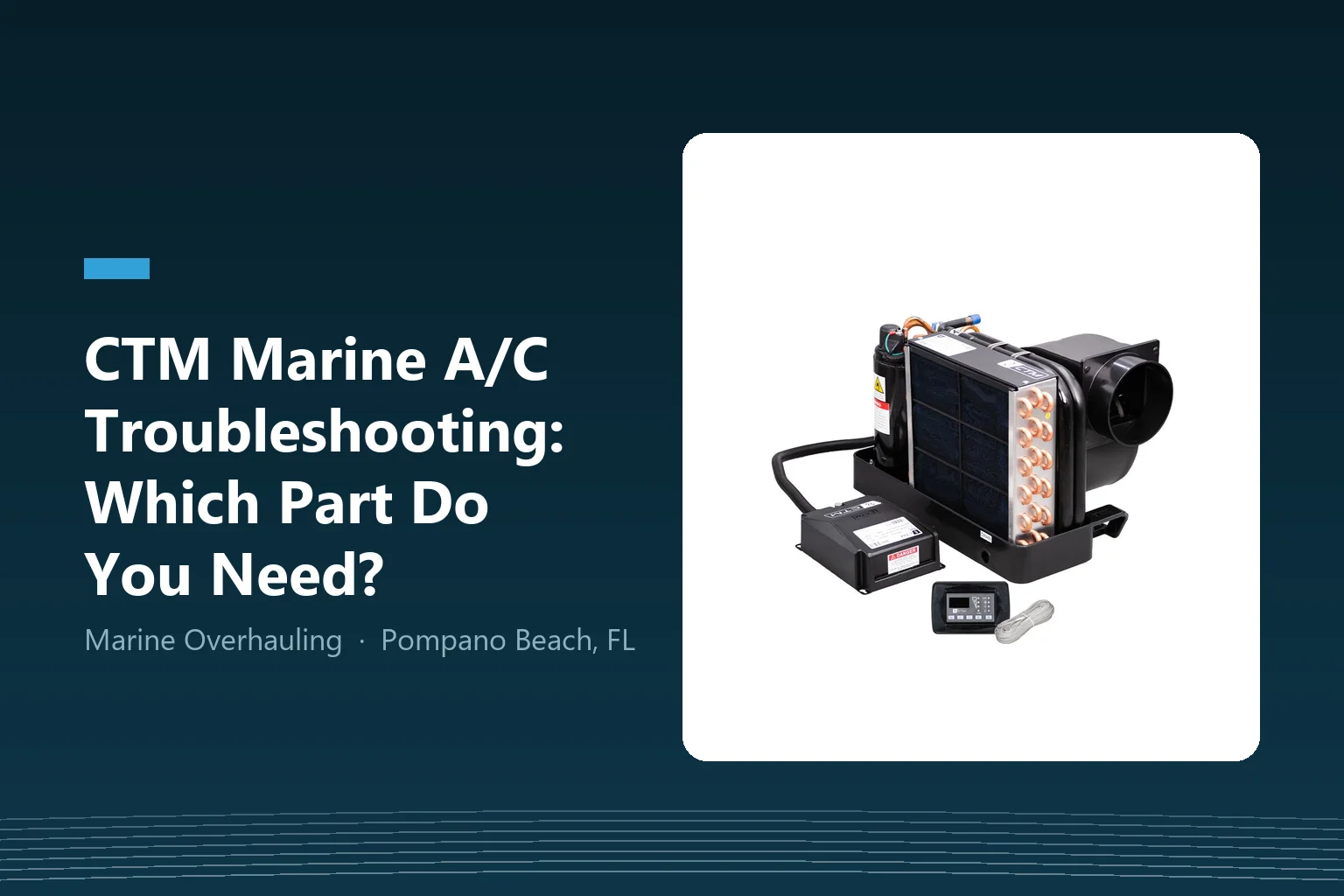
When a CTM marine air conditioner stops cooling, the fault is usually one of a handful of parts: a clogged air filter, a tired run capacitor, a failing blower assembly or a seawater flow problem. Marine Overhauling stocks genuine CTM replacement parts in Pompano Beach, FL, from filters and capacitors to compressors and control boards, with free shipping on orders over $199 and local pickup. This guide matches each symptom to the part that usually fixes it.
First, two checks that cost nothing
Before replacing any part, rule out the two most common causes of a marine A/C “failure”. Seawater flow: a marine air conditioner rejects heat into raw water. If the overboard discharge is dribbling instead of streaming, clean the sea strainer and check the through-hull is open. Airflow: pull the return air filter and hold it up to a light. If you cannot see light through it, the unit has been suffocating. Both problems imitate expensive failures, and both are ten-minute fixes.
Weak airflow, or the unit freezes up
Ice on the evaporator coil or a weak stream from the vents almost always starts with airflow, not refrigerant.
- Dirty filter: replace it, they are sized by unit capacity: 6k BTU, 6-8k, 10-12k, 16k and 24-25k BTU.
- Blower running slow, rattling or stopped: the squirrel-cage blower assembly wears out after years of salt air. CTM’s turbo blowers fit the CT, DTU, STX, STQ, SXR, VTD, VCP and VRP families and are matched by capacity and voltage: 6-8k 115V, 6-8k 230V, 10-12k 115V, 10-12k 230V, 14-16k 115V, 14-16k 230V and 24-25k 230V.
Unit hums, will not start, or trips the breaker
A compressor that hums and clicks off, or a fan that will not spin up, points at the electrical side.
- Run capacitor: the most common electrical failure on any marine A/C, and the cheapest. Match it to your unit’s capacity and voltage from the CTM parts range, from 6k BTU 115V up to 24-36k BTU 230V. A swollen top or oily residue on the old capacitor confirms the diagnosis.
- Contactor: on 220V systems with a separate high-load contactor, burned or pitted contacts stop the compressor from engaging. The Hartland 220V 40A contactor is the direct replacement.
- Control board: if the display lights up but relays never click, the U-board may have failed. The U-Board version 2.0 replaces OEM boards 223100502 and 223100504.
Runs, but no cold air
- Seawater pump not moving water: without raw water flow the system builds head pressure and cuts out. We stock 250 GPH pumps for systems up to 10k BTU and 500 GPH pumps for up to 16k BTU.
- High pressure switch tripping: if the unit shuts down on high pressure even with good water flow, the R410A high pressure switch itself may have drifted.
- Compressor at end of life: when the compressor is seized or has lost capacity, CTM offers drop-in R410A replacements by size and voltage, for example 10k 115V, 12k 230V and 14-16k 230V. Refrigerant work is a job for a technician; see our marine air conditioning service.
Cools fine, but will not heat
CTM reverse-cycle units heat by reversing refrigerant flow. If cooling works and heating does not, the reversing valve circuit is the suspect: first the solenoid coil (also in 230V), and if the valve itself is stuck, the full reversing valve assembly for 6-12k, 14-25k or 36k BTU units.
Display or thermostat problems
A dead or erratic keypad on an otherwise healthy unit can be replaced rather than living with it: the Elite II control with 8-pin connection is the standard upgrade, and wall cover plates tidy up the old cutout.
How to identify your unit
Every CTM unit carries a data plate on the chassis with the model and voltage. The model tells you the family and capacity: CT-12 is a 12,000 BTU self-contained unit, CX-16 a 16,000 BTU split condenser, EV-10 a 10,000 BTU evaporator. The suffix tells the voltage: no H means 115V, H means 230V. Match both when ordering a capacitor, blower or compressor: a 115V part on a 230V unit fails immediately. If the plate is unreadable, call us at (786) 277-2596 with photos and we will identify it.
When repair stops making sense
A filter, capacitor or solenoid is always worth fixing. When an old unit needs a compressor AND a blower, or parts for it are discontinued, a modern replacement usually wins on cost and current draw. CTM’s complete retrofit kit and retrofit package with SMXir display are built for exactly that swap, and the NMEA 2000 retrofit kit adds network monitoring. To size a new unit correctly, use our marine air conditioner sizing guide, and if you want it installed rather than shipped, our A/C service in Pompano Beach handles diagnosis, replacement and sea trials.
CTM marine A/C parts FAQ
Why does my marine A/C keep shutting off on high pressure?
High pressure shutdowns almost always mean the unit cannot reject heat into the seawater loop. Check the sea strainer, the through-hull and the circulation pump before replacing parts. If water flow is strong and the alarm persists, the high pressure switch itself may have drifted out of range.
How do I know if the capacitor is bad on my marine air conditioner?
Typical signs are a compressor that hums but does not start, a blower that needs a push to spin, or a unit that trips the breaker at startup. Visually, a swollen top or oily residue on the capacitor confirms it. Always match capacity (BTU) and voltage when replacing.
Can I replace CTM A/C parts myself?
Filters, capacitors, keypads and pumps are owner-serviceable with basic tools, with power off at the breaker. Anything that opens the refrigerant circuit, such as a compressor or reversing valve, requires recovery equipment and should be done by a technician.
Do CTM parts fit only CTM air conditioners?
CTM blowers and boards list the unit families they fit, and several parts cross over to common OEM components, such as the U-Board that replaces OEM boards 223100502 and 223100504. Check the data plate on your unit and the fitment notes on each product page, or call us with the model number.
Is it worth repairing a 15-year-old marine air conditioner?
For a cheap part like a capacitor or filter, yes. If the compressor is gone on a unit that old, a modern R410A replacement or retrofit kit usually costs less over time, cools better and draws less current. Sizing the new unit correctly matters more than brand.